
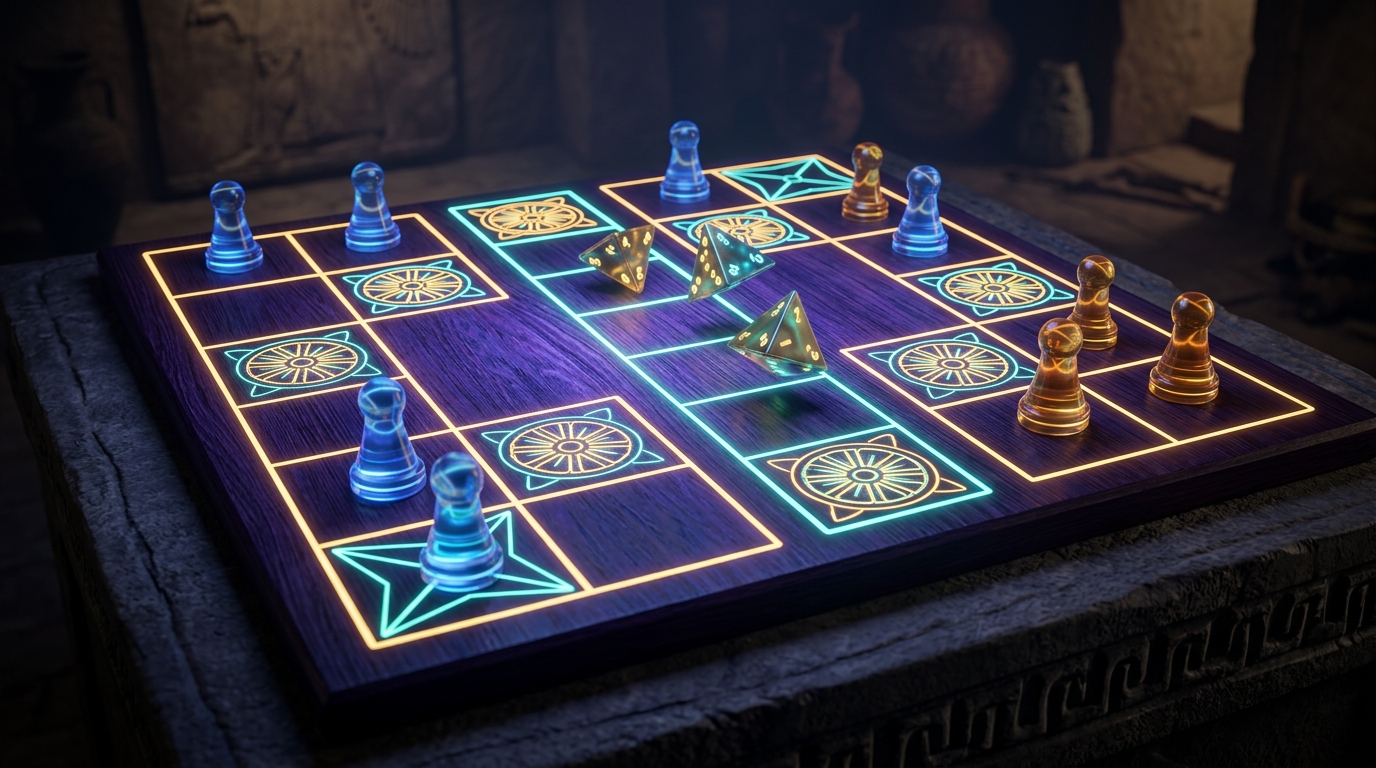
Step back 4,500 years to the cradle of civilization. Royal Ruckus brings the historic Royal Game of Ur, the grandmother of all race games, to the modern age, complete with randomized boards, pyramidal binary dice, and advanced heuristic AI advisors.
1. Game Overview
In the Elegonn vs Player app, Royal Ruckus is played as a tactical race game for two players. Each player has 7 pieces they must move along a shared central track before exiting the board. The movement is governed by rolling 4 binary pyramidal dice (four-sided dice where two of the four corners are marked).
Unlike simple roll-and-move games, Royal Ruckus requires managing piece distributions to block opponents, claiming high-value safe spots (Rosettes), and balancing aggressive captures against safe progress.
"Safety is an illusion on the central bridge. Only the Rosette guards your piece from the opponent's strike."
2. History: Who, What, When, Why, Where
- Who: The royalty of ancient Mesopotamia (discovered in the Royal Tombs of Ur by Sir Leonard Woolley).
- What: A two-player race board game played on a unique 20-square grid with rosette symbols.
- When: Originating around 2600 BCE, making it one of the oldest known board games in human history.
- Why: A combination of tactical planning, probability management, and spiritual divination.
- Where: Played throughout the ancient Near East, Middle East, and Mediterranean; now rebuilt in Kotlin Multiplatform.
3. The Real-World History of Ur
The Royal Game of Ur was forgotten for millennia until the 1920s, when archaeological excavations in modern-day Iraq unearthed beautifully decorated boards made of lapis lazuli, shell, and carnelian. The rules were reconstructed decades later by British Museum curator Irving Finkel, who translated a second-century BCE cuneiform tablet written by the Babylonian scribe Itti-Marduk-balāṭu.
The game's 20-square layout represents a journey down a river or a path of life. The five marked rosette tiles represent points of good fortune. Because players share the middle 8-tile lane, the game is highly combative, forming the direct ancestor to modern backgammon.
4. Gameplay Rules
Each player starts with 7 pieces off-board. Your goal is to move all 7 pieces along your designated track and exit the board:
- Track Geometry:
- Pieces enter the board on your private lane (tiles 1 to 4).
- They merge onto the shared central lane (tiles 5 to 12) where captures can happen.
- Finally, they branch off onto your private exit lane (tiles 13 and 14) and must roll exactly to exit (tile 15).
- The Pyramidal Dice: Roll 4 four-sided dice. Each die has 2 marked tips. The number of marked tips pointing upwards is your roll (giving a probability distribution from 0 to 4).
- Rolling a 0 means your turn is skipped.
- Rosette Tiles (Safe Havens): The five tiles at path positions 4, 8, and 14 are Rosettes.
- A piece sitting on a Rosette is completely safe and cannot be captured.
- Landing on a Rosette grants you an immediate free double roll.
- Capturing: Landing on a tile occupied by an opponent's piece on the shared lane (tiles 5 to 12) captures it, returning the opponent's piece back to their starting pool.
- Randomized Maps: Royal Ruckus includes a modern twist: you can randomize the rosette positions on the board, creating entirely new choke points and safe zones each match.
5. Heuristics & Strategies
Our gameplay advisor uses a combination of probability matrices and distance calculations to recommend moves:
Control the Rosettes: Rosettes are the key to victory. Not only do they provide safety on the combat lane, but the bonus turn allows you to pull ahead or escape danger. Prioritize landing on the middle Rosette (tile 8) to establish control of the board.
Block and Capture: Since the central lane is only one tile wide, look for opportunities to block the opponent's advance. Landing a piece just behind an opponent's piece puts pressure on them, as they must roll high to escape your capture range.
The Exit Exactness: Pieces need an exact roll to leave the board from tile 14. Keep multiple pieces active near the end of the track to increase your chances of having a valid move if you roll low.
Randomized Adaptation: When playing on a randomized map, look for adjacent rosette clusters. If two rosettes are close together, pieces can leap from one safe spot to another, making the mid-game race much faster.